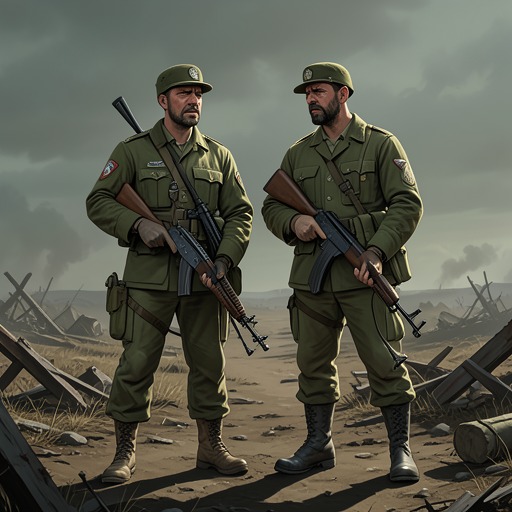
Have each other’s backs
Fool Me OnceHave each other’s backs is the rule of mutual protection Maya Stern learned in the military: fellow soldiers must know that if an enemy comes for one of them, the others will stand with them. The principle gives Maya a language for loyalty, but the story follows it beyond the battlefield, where her promise to protect family and her choices in combat reveal how solidarity can sustain people—and how narrowly drawn loyalties can endanger others.
Military Origin and Meaning
Maya describes the rule as the first and foremost lesson of military life. It is practical as well as emotional: soldiers must be able to trust that their companions will respond when they are under attack. In her formulation, an enemy targeting one soldier is targeting the group. Protection is therefore mutual, immediate, and bound to the risks shared by those serving together.
The rule also shapes Maya’s understanding of responsibility. It does not mean simply feeling concern for another person; it means being prepared to act on that concern. That readiness becomes central to how she understands her role among people she loves, even when the setting is no longer a military mission.
From Comradeship to Family Protection
After Maya humiliates Coach Phil for mistreating her niece Alexa, she worries that she has taught the child the wrong lesson about violence. Alexa’s small smile changes what Maya reads in the moment: Maya understands that her niece has recognized someone will stand up for her. Maya allows that her response may have been an overreaction, but insists that she will defend Alexa until the girl can defend herself.
Daniel, who had moved toward the commotion in an effort to help, also nods in recognition. The children have lost their mother, and their father is a drunk; within that family vulnerability, Maya’s protection matters. The military rule has become an assurance to Alexa and Daniel that they are not alone. Its civilian application is not a copy of battlefield procedure, but an extension of Maya’s conviction that loyalty requires action when someone is threatened.
The Rule in the Al Qa’im Mission
The principle takes a more dangerous form during the rescue mission in Al Qa’im. Maya and Shane are flying in a Boeing MH-6 Little Bird when two soldiers, pinned down after an ambush, call for help; four others, including three people Maya knew and loved, have already been killed. A black SUV is moving toward the survivors. Maya and Shane wait for confirmation from Joint Operations Command, but the radio connection is intermittent, while the soldiers’ desperate calls come through clearly. When the survivors scream, Maya fires an AGM-114 Hellfire missile at the SUV. The infantry then reaches the two soldiers, both of whom have been hit but survive.
The rescue appears righteous to Maya at the time: her action saves the two remaining soldiers. Later, however, she tells Shane that they never received authorization to strike. Joint Operations Command had ordered them to hold off because it believed at least one person in the SUV might be a civilian, possibly underage, and assessed only a fifty-fifty chance that the occupants were enemy fighters. Maya had turned off her signal and concealed that message from Shane, making the decision herself.
Maya explains that she acted because she cared about the soldiers and would not lose another of their own if she could prevent it. She says civilian deaths did not deter her; she accepted them as collateral damage. The rule that once describes reciprocal protection among comrades has, in this moment, become a priority that places the lives of her own group above the uncertain lives of the people in the SUV. The mission’s outcome—two soldiers saved, civilians killed—makes the rule’s reach and its moral limit inseparable.
Trauma, Loyalty, and the Cost of Repetition
Maya rejects the idea that guilt over the civilian deaths is what haunts her. Her flashbacks are auditory, and she says the dead do not haunt her because she feels guilty; what remains with her is knowing that she would make the same choice again. Each night, she relives the mission without being able to change its outcome, trying again to save the soldiers. Shane recognizes the other side of that repetition: in each return, the civilians are killed again.
The distinction complicates any simple reading of the rule as either noble or corrupt. Maya’s commitment to her comrades is sincere, and the two rescued soldiers’ survival gives it immediate force. But her loyalty also helps explain why she overrides an order and accepts the deaths of people whose identities are uncertain. The rule offers no assurance that protecting one group will protect everyone caught in the same decision.
At the end of Maya’s story, Shane’s retrospective account preserves the contradiction. He remembers her as a good person while acknowledging that she killed civilians and executed a man, and he wonders whether her nightly flashbacks are compatible with her claim that she felt no remorse. He connects the death that stayed with Maya after Iraq to her determination that it should not follow Lily. Have each other’s backs thus extends from military comradeship to Maya’s defense of vulnerable family, while remaining shadowed by the lives lost when her sense of whom she must protect narrows to her own.